
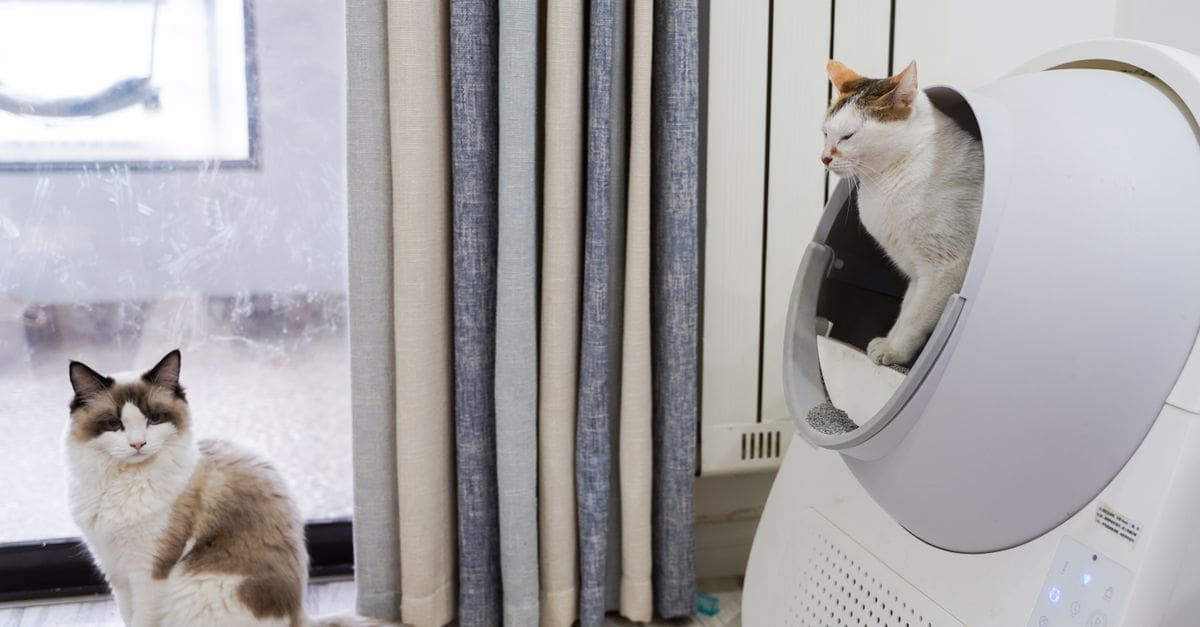
What to Know Before Buying a Self-Cleaning Litter Box
Automatic raking or rotating mechanisms remove waste after each visit, which keeps odor down and cuts the daily scooping chore. Entry size and interior dimensions decide whether a cat will actually use the unit, and many refuse anything that feels cramped. Safety sensors matter because a moving mechanism and a curious animal share the same space. Waste capacity and litter compatibility determine how often you interact with it.
Mechanism Types and How They Work
Raking systems sweep a comb through the litter after a set delay, pushing clumps into a sealed compartment. They work with standard clumping litter and are mechanically simple, though the rake can jam on large clumps or stuck debris.
Rotating globe designs turn the entire chamber so litter sifts through a screen and waste falls into a drawer. They handle volume well and rarely jam, but they are physically large and the rotation noise can startle a nervous cat.
Size, Entry, and Cat Comfort
Interior floor space should let a cat turn around fully and dig, which generally means at least one and a half times the cat’s body length. Cramped units are the leading reason cats reject an automatic box entirely.
Entry height matters for kittens, senior cats, and any animal with arthritis, and a high step-over lip becomes an obstacle. Large breeds need proportionally larger units, and many manufacturers state a maximum recommended cat weight that is worth checking against your animal.
Safety Sensors and Mechanism Timing
Weight sensors or infrared beams detect a cat entering and pause the cycle, restarting only after a delay. Redundant sensing, using both weight and infrared, is safer than either alone since a light cat may not trigger a weight plate.
Adjustable delay timing lets you set how long after departure the cycle runs, which matters for cats that re-enter quickly. Confirm the mechanism reverses or stops on obstruction, and that it can be paused entirely while a cat adjusts to the unit during the introduction period.
Waste Capacity and Odor Control
Sealed waste compartments contain odor far better than open drawers, and capacity determines how many days pass between emptying. A multi-cat household fills a compartment several times faster than a single cat.
Carbon filters absorb residual odor, and some units add an exhaust fan. Check whether the unit requires proprietary waste bags or liners, since ongoing consumable costs can quietly exceed the purchase price over a few years, and generic bag compatibility saves considerably.
Litter Compatibility and Running Costs
Most automatic units require clumping clay litter because the mechanism relies on solid clumps forming. Crystal, pine, and paper litters often do not clump firmly enough and can jam the mechanism or pass straight through the sifting screen.
Litter depth affects performance, with too little producing clumps that stick to the floor and too much overloading the rake. Following the manufacturer’s fill line matters more here than with a manual box, and factoring in litter, bags, and filters gives the true monthly cost.
Noise, Power, and Maintenance
Mechanism noise varies from a quiet hum to a noticeable grinding, which affects both cat acceptance and household peace if the box sits near a living area. Reading about noise from actual owners is more informative than manufacturer claims.
Most units need mains power, so a nearby outlet is required, and some offer battery backup for outages. Periodic deep cleaning is still necessary since urine reaches surfaces the mechanism does not, so check whether the unit disassembles for washing and whether parts are dishwasher safe.
What to Check Before You Buy
- Confirm interior floor space suits your cat’s size with room to turn and dig.
- Check entry height for kittens, senior cats, or animals with mobility issues.
- Look for redundant safety sensing using both weight and infrared detection.
- Verify the cycle delay is adjustable and the mechanism stops on obstruction.
- Match waste compartment capacity to the number of cats in your household.
- Check whether proprietary bags and filters are required and price them out.
- Confirm the unit takes standard clumping litter and disassembles for cleaning.
How to Choose a Self-Cleaning Litter Box
Starting with your cat’s size and temperament matters more than any feature list.
- Measure your cat and confirm the interior gives room to turn fully.
- Consider your cat’s age, mobility, and tolerance for mechanical noise.
- Choose a mechanism type suited to your litter and household size.
- Verify safety sensing and adjustable timing before anything else.
- Calculate ongoing costs for litter, bags, and filters.
- Confirm placement near an outlet and plan a gradual introduction period.
Ready to shop? Browse our full list of Self-Cleaning Litter Boxes to compare current options and prices.


