Compact Countertop Toaster Ovens for Small Kitchens
A compact countertop toaster oven can be a smart choice when kitchen space is limited, but small size alone does not guarantee convenience. The appliance still needs enough interior room to handle your real foods, enough clearance to operate safely, and controls that remain easy to use in a tight layout. The best compact models feel intentional rather than shrunken. They save space without making every meal feel like a compromise.
Why Compact Countertop Toaster Ovens Appeal to Small Kitchens
Small kitchens reward appliances that do one job well and do not dominate the room. A compact toaster oven can offer faster access than a full-size oven while preserving precious prep space. For apartments, condos, dorm-style kitchens, and narrow counters, footprint may be the deciding factor.
The challenge is choosing a compact appliance that still feels useful. Some models look tidy but have interiors too shallow for common foods. Others save width but grow tall or deep in ways that complicate placement. Compact shopping requires looking at the whole shape, not just the word small.
Visual space matters too
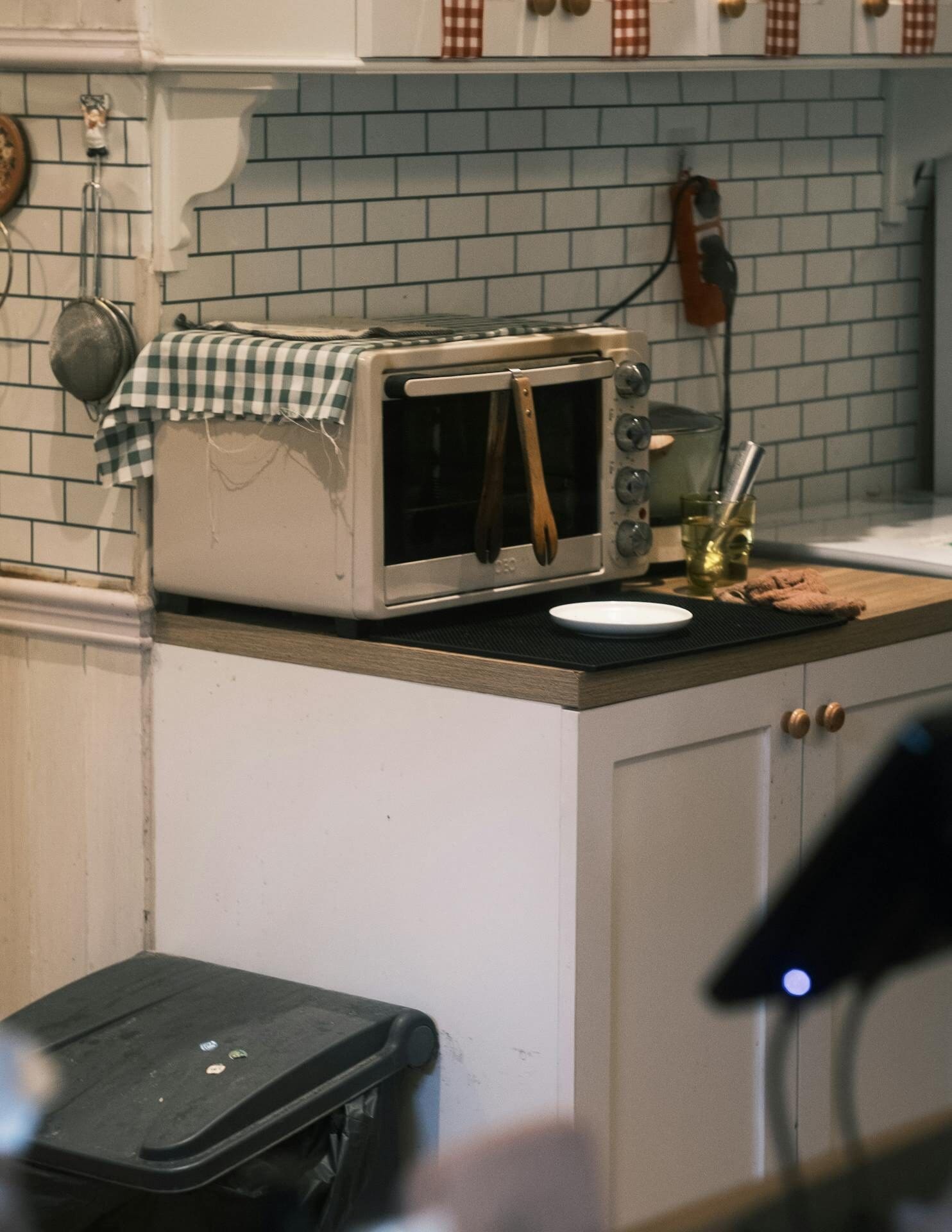
An appliance can technically fit and still make a kitchen feel crowded. Compact toaster ovens with clean lines, simple doors, and modest height often blend in better on exposed counters. If your kitchen already has several countertop items, the visual footprint may matter almost as much as the measured footprint.
Measure the Spot Before Comparing Models
Small-space purchases should begin with the counter, not the appliance catalog. Measure the width, depth, height, nearby outlet location, and open room in front of the appliance. Then account for clearance around hot surfaces and the door swing.
- Measure the maximum width you can spare without losing prep space.
- Check depth from backsplash to counter edge.
- Leave room for the door to open fully.
- Confirm cabinet clearance above the appliance.
- Make sure the cord can reach without crossing a work area.
Interior Room Still Matters
A compact toaster oven should be small outside but not useless inside. Look closely at tray dimensions, rack placement, and usable height. A model that holds a few slices of bread may be fine for breakfast but limiting if you want to reheat small plates or cook individual meals.
The foods that reveal real capacity
Instead of relying on vague capacity claims, imagine specific foods. A single sandwich, a small serving of leftovers, a personal flatbread, or a handful of appetizers all tell you more than a slice count alone. If those foods fit comfortably, the appliance is more likely to work in daily life.
- Toast and bagels need even top and bottom heat.
- Leftovers need enough height for small dishes or trays.
- Frozen snacks need tray width and airflow around the edges.
- Open-faced foods need clearance from the top elements.
Controls for Tight Spaces
Compact appliances are often placed in corners or below cabinets, so control placement becomes important. Front-facing dials or displays are easier to access than controls positioned awkwardly near the side. Labels should remain readable when the appliance is tucked into its normal spot.
Simple controls reduce friction
In a small kitchen, you may use the toaster oven while moving around limited counter space. Clear controls help you set the appliance quickly and step away. Overly complex menus can feel more irritating when the appliance is squeezed into a narrow work zone.
Storage Versus Permanent Counter Placement
Some compact toaster ovens are bought with storage in mind, but that only works if the appliance is light enough and shaped well enough to move. A unit with awkward side grips or a heavy door may not be pleasant to lift in and out of a cabinet. If it will live on the counter, ventilation and appearance become more important.
Think honestly about your habits. If you use toast or reheated foods daily, storing the appliance may become annoying. A slightly better-looking compact model that can stay out may be more practical than the smallest possible one hidden away after every use.
Features Worth Keeping in a Compact Model
Compact does not have to mean bare bones. Some features are especially valuable in small kitchens because they reduce the need for extra tools or make the appliance easier to monitor. The key is to avoid feature creep that makes the oven larger than necessary.
- Interior light if the appliance sits in a dim corner
- Front-removable crumb tray for easier access
- Two rack positions if interior height allows it
- A clear timer that can handle both toast and small meals
- A stable tray that uses most of the interior width
When Compact Is Not the Right Choice
A compact model is not ideal for every home. If you regularly cook for several people, want to use wider pans, or expect the appliance to replace a full-size oven for many meals, a small cavity may frustrate you. Saving counter space only helps if the appliance still does the work you bought it to do.
Do not undersize out of habit
Some shoppers automatically choose the smallest appliance because they dislike clutter. That instinct is understandable, but it can backfire when the oven cannot fit the foods you actually wanted to make. The better approach is to choose the smallest size that still supports your normal routine.
Choosing a Compact Toaster Oven With Confidence
A compact countertop toaster oven is a strong choice when it balances footprint, interior usability, and easy controls. It should make a small kitchen more functional, not create a new puzzle every time you cook. Measuring carefully and thinking through real meals will do more than any feature comparison alone.
The right compact model preserves counter space while still feeling dependable for everyday tasks. It fits the room, handles your usual foods, and remains easy to reach. When those pieces line up, small size becomes an advantage rather than a limitation.