What to Know Before Buying an Air Compressor
An air compressor is only as useful as its ability to match the demands of the tools you plan to run. Before buying, the most important spec to understand is CFM — cubic feet per minute — because a compressor that can’t deliver enough airflow for your tools will underperform no matter how large the tank. Tank size, PSI range, oil type, and form factor all matter, but they’re secondary to getting the CFM right for your specific use case.
Match CFM output to the tools you plan to run
Every pneumatic tool specifies a CFM requirement, and your compressor must meet or exceed it. Framing nailers and brad nailers are among the lightest users, typically requiring 0.5 to 1.5 CFM. Impact wrenches need 3 to 6 CFM depending on size. Angle grinders and die grinders pull 5 to 8 CFM. Spray guns and paint sprayers are the highest-demand tools, often requiring 8 to 20 CFM or more for continuous use. If you plan to run multiple tools at the same time — which is common in production or shop settings — add up the individual CFM requirements of all simultaneously running tools and use that total as your minimum. Compressor CFM ratings are typically given at 90 PSI, which is the standard operating pressure for most pneumatic tools.
Tank size determines how long you can run continuously
The tank stores compressed air so your tools can keep running while the pump motor cycles on and off to recharge. A larger tank means more stored air and a longer run time before the motor needs to kick back in. For intermittent tools like nailers — which fire a burst of air and then wait — even a small 1- to 3-gallon tank is sufficient because the tank refills during the pauses between shots. For continuous-use tools like sanders, grinders, or paint guns, a larger tank of 10 to 30 gallons prevents the compressor from running constantly, which reduces wear on the motor and provides more consistent pressure to the tool. For most home workshop use, a 4- to 6-gallon tank handles the majority of tasks well.
PSI range and what regulated outlet pressure means
Most pneumatic tools operate at 70 to 90 PSI, and nearly every compressor on the market exceeds this — typical models are rated for 125 to 150 PSI maximum tank pressure. The tank PSI is how much pressure the compressor stores; the outlet PSI is the regulated pressure delivered to the tool. A regulator on the compressor lets you dial down the outlet pressure to match the tool’s requirement, so buying a compressor with a higher maximum tank PSI gives you headroom to maintain consistent outlet pressure even as the tank drains. A compressor that only stores 90 PSI will deliver inconsistent pressure to tools as the tank empties. Aim for a maximum tank PSI of at least 125 PSI for general workshop use.
Oil-free vs. oil-lubricated — maintenance and longevity tradeoffs
Oil-free compressors use Teflon-coated or permanently lubricated pump components that require no oil changes. They’re lighter, require less maintenance, and are the dominant choice for portable and occasional-use applications. The tradeoff is a shorter pump lifespan and higher noise levels compared to oil-lubricated models. Oil-lubricated compressors run quieter, last longer under heavy use, and are the standard choice in professional shops and industrial settings. They require regular oil level checks and periodic oil changes, similar to a small engine. For a home DIY user who runs the compressor a few times per month, oil-free is typically the right call. For daily professional use or a shop that runs the compressor for hours at a time, oil-lubricated is the more durable and cost-effective choice over the long term.
Tank styles and portability
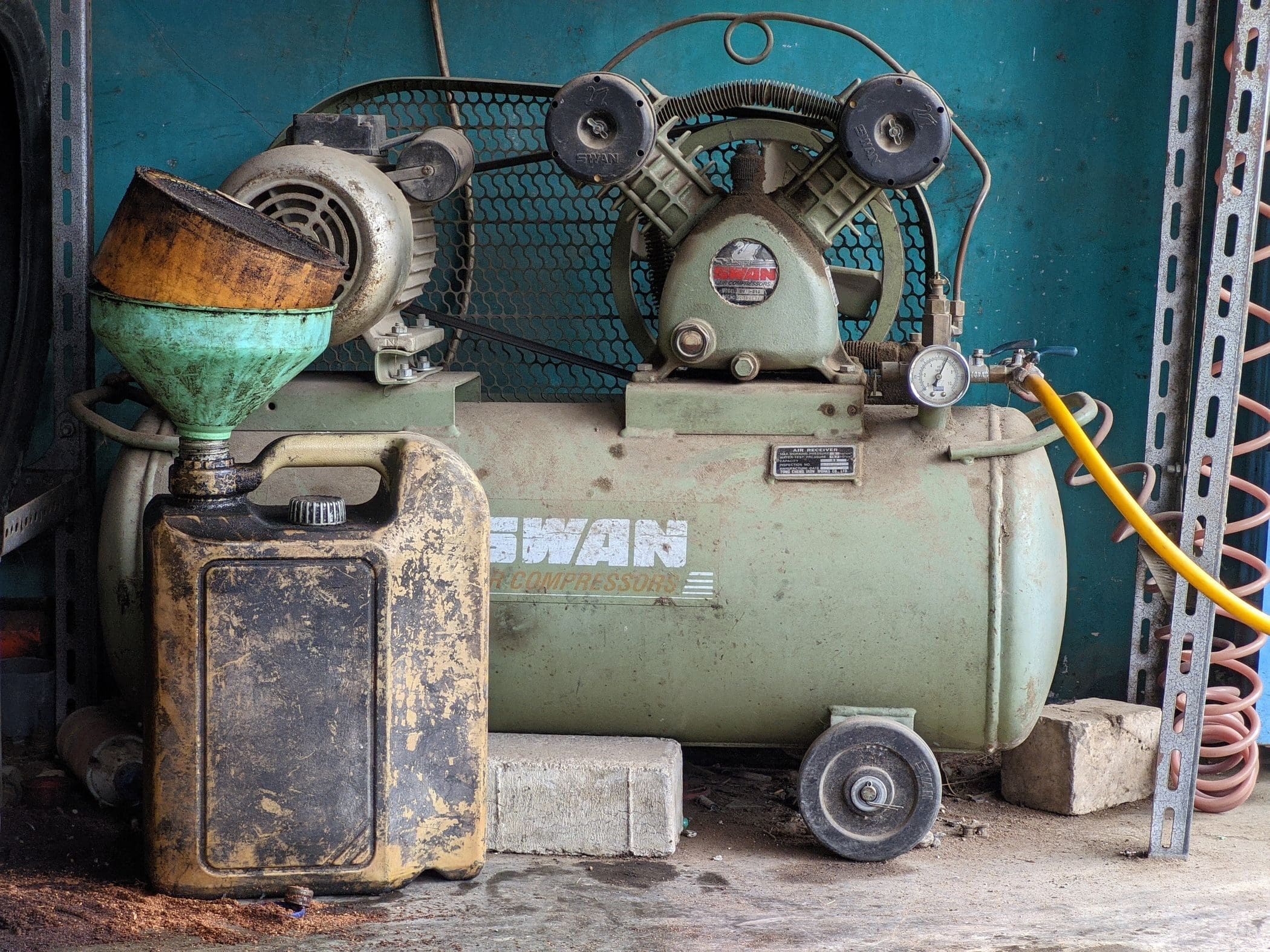
Pancake compressors — with a flat, circular tank — are the most popular portable option because of their low center of gravity and stability. They’re typically 1 to 6 gallons and handle most trim carpentry and nail gun work easily. Hot dog compressors have a horizontal cylindrical tank and a similar capacity range. Twin-stack compressors use two horizontal tanks stacked together to increase capacity while remaining portable — a good middle ground for users who need more than a pancake provides. Vertical stationary compressors with tanks of 20 to 80 gallons are fixed workshop tools, not designed to be moved. Gas-powered compressors are built for outdoor job sites without electrical access; for any indoor use, electric models are the only viable option because of exhaust.
Noise level in real-world use
Air compressors are loud — most standard models run between 70 and 90 decibels during the pump cycle, which is louder than a conversation but not immediately harmful for short exposures. If you work in an attached garage, a shared space, or indoors with thin walls, noise becomes a more significant factor. Some manufacturers market “quiet” or “ultra-quiet” compressors at 60 to 70 dB, which is noticeably less disruptive. These tend to cost more and are usually oil-lubricated. The pump cycle is not continuous — the compressor runs loudly to fill the tank, then cuts off until pressure drops again — so a larger tank means fewer and shorter loud cycles during a work session.
What to check before you buy an air compressor
- List every pneumatic tool you plan to run and look up the CFM requirement for each — buy a compressor that delivers at least the highest single-tool CFM requirement, or the sum if running multiple tools at once
- Match tank size to your use pattern — small tanks for nailers and inflation, larger tanks for grinders, sanders, and painting
- Check maximum tank PSI rather than just outlet PSI — aim for 125 PSI or higher for consistent regulated pressure
- Decide between oil-free and oil-lubricated based on how often you’ll use it and whether you’re willing to do periodic maintenance
- Match the form factor to where you’ll use it — pancake for portability, vertical stationary for shop use, gas-powered only if you need to work without power access
- Check real-world noise reviews if you’ll be using it in a shared or indoor space
How to choose an air compressor
Work through these steps before buying:
- List every tool you plan to run and note the CFM requirement at 90 PSI for each — the compressor must meet the highest individual requirement, or the combined total for simultaneous use.
- Determine your use pattern: intermittent nail gun work points to a small portable tank; continuous painting or grinding requires a larger tank to avoid constant cycling.
- Check whether oil-free or oil-lubricated fits your maintenance preferences and usage frequency — oil-free for occasional DIY, oil-lubricated for daily shop use.
- Choose the right form factor for where you’ll use it — pancake or twin-stack for portability, vertical stationary for a fixed workshop setup.
- Verify the maximum tank PSI is at least 125 to ensure consistent regulated outlet pressure as the tank drains during use.
- If noise is a concern for your space, look at models specifically marketed as quiet and check decibel ratings in real-user reviews rather than spec sheets alone.
Ready to shop? Browse our full list of Air Compressors to compare top-rated options.